All Categories
Featured
Evaluating 2026 Term Insurance Premiums
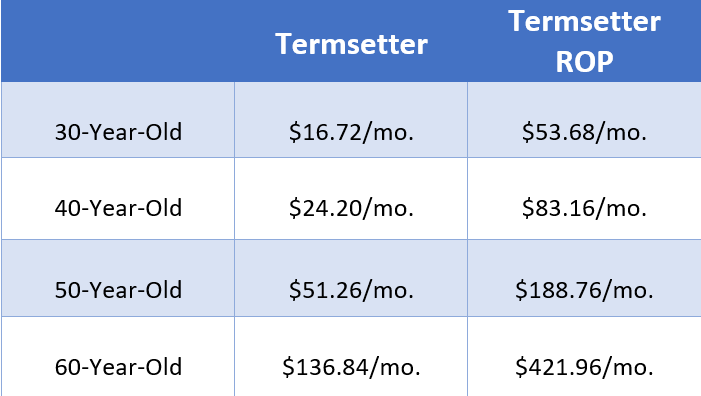
The cost of an indexed universal life insurance coverage policy varies, depending on factors like your age, where you live, your health and the coverage amount you choose. According to one quote, a healthy, nonsmoking 34-year-old woman may pay between$71 and $96 a month for an indexed universal life policy, assuming$250,000 of coverage. The exact same individual might pay$32 to$44 a month for a term life policy and between $177 and$245 per month for an entire life policy.
Insurance in La Habra CAIt's also a good alternative if you believe you'll require to change your premium and death benefit. You may not require a life insurance coverage policy after you've paid off your financial obligations and conserved for your big monetary objectives, like retirement and your kid's college education. In these situations, a term life insurance policy with a different retirement fund and other savings cars may offer what you require, and at a lower cost. An independent representative can walk you through your alternatives to discover the right coverage amount for the very best price with a respectable insurer. As soon as you have a couple of quotes, you need to: Compare protection limits, estimated regular monthly payments and administrative or management fees that include each policy. Select a policy and an insurer. The business might ask you to go through a phone interview or medical examination. When approved, start paying premiums regularly. Indexed universal life insurance offers irreversible coverage with a death advantage and a money worth that grows based on underlying financial investments. You can either allocate the money value portion in a fixed account, an indexed account or both.
These are complex policies that may need some oversight, so it is necessary to work with a financial coordinator or another accredited professional before selecting one. You may likewise compare IUL policies versus other kinds of life insurance to see what works best for your situation. Depending upon who you ask, indexed universal life (IUL) insurance is either an effective wealth-building strategy or an overly complicated insurance coverage product that promises more than it delivers. The fact might lie someplace in the middle . An IUL is first and primary a life insurance coverage policy. Like other permanent life insurance coverage products, it can offer lifelong protection and develop cash value in time. Instead of making a fixed rate of interest, it's tied to the performance of a stock market index, such as the S&P 500. Here's how indexed universal life insurance coverage works, who it may be a great fit for, and what to understand before buying a policy. Indexed universal life insurance coverage is a kind of irreversible life insurance that integrates a survivor benefit with a cash worth account. Unlike whole life insurance coverage, which credits your money value at a fixed interest rate, an IUL ties your money value growth to the efficiency of a market index, such as the S&P 500, the Dow Jones Industrial Average, or the Nasdaq Composite(thus the "indexed"part of the name). Every premium payment you produce a UIL policy is typically split 3 ways: As with all cash value life insurance coverage, you may have the ability to obtain versus your balance, withdraw funds, and even use it to assist cover future premiums. Instead, the insurance provider uses the index as a benchmark to determine how much interest to credit to the cash value part of your policy. If the index performs well, your money worth might earn more interest. If the index has a bad year, your credited interest might be lower(in some cases even 0%), depending upon your policy's terms. If your policy credits the.
HMO vs HMO: Selecting the Plan
complete 10%, your money worth could earn about $5,000 in interest before fees and policy charges. When you hear that an IUL's money value is linked to the stock exchange, you might assume you'll make whatever the market earns. That's seldom how it works. A cap is the maximum interest your policy can make during a crediting duration. You can typically find your cap in your policy illustration or documents.

Suppose your policy has a 10 %cap, and the market index gains 15%that year. Despite the fact that the index increased by 15 %, your policy would only be credited 10 % before charges and other policy charges. Numerous IUL policies have a 0 %flooring, indicating you won't lose money worth just due to the fact that the underlying market index has a negative year. If the index falls 18%, your credited interest might be 0%rather of -18%. That stated, a 0 %floor safeguards you from market losses, not from policy costs. An involvement rate determineshow much of the index's gain is credited to your policy. If your policy has an 80 %involvement rate and the index increases 10%, you would receive 8%interest (80%of the index's gain), presuming no cap restricts the return. If the participation rate is 100 %, you would make the complete 10 %as long as it does not go beyond the cap. Two policies tracking the exact same marketindex can produce really different outcomes depending upon how these features are structured. Most indexed universal life policies let you select in between two kinds of survivor benefit: Your recipients receive a repaired survivor benefit throughout the life of the policy. As your cash worth grows, it generally enters into that total death benefit rather than being paid in addition to it.

Latest Posts

Understanding Whole Life Insurance Works for Wealth

Explaining How Whole Life Insurance Protects Your Future
Evaluating 2026 Term Insurance Premiums